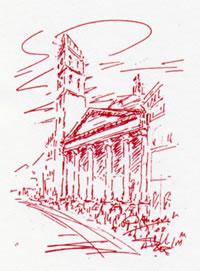
The four Corinthian columns, the cornices and the frontispiece of the altar are made of terracotta with a façade of stucco and embellished with gold. The other parts and the putti are made entirely of stucco.
In the middle of the frontispiece, a painting by Giorgetti depicts God the creator, encircled by angels in the act of embracing all of creation.
Over the painting, there was a Latin inscription (now preserved behind the altar): «This glorious temple, already dedicated to Minerva, the goddess of false wisdom (now consecrated) to the Mother of true wisdom».
On the cornice, in relationship with the Corinthian columns, there are symbolic statues of Purity and of Charity, as well as two very great angels. The other two smaller angels sit upon a small semi-circular cap, above which is the radiant monogram of the Virgin, between two small putti.
Halfway up, from column to column, flutter two putti of good workmanship that stand in relief on every side.
At the top, on the ceiling, in the rear, one can admire many putti in glorious form, carrying flowers in a lively and festive manner.
On May 8, 1758, the Third Regular Order, having built the new convent of San Antonio with an attached church, left the temple to the Congregation of the Oratory of "San Fillippo Neri".
The Fillippines immediately constructed a large convent (actually the Bozzoni palace) and dismantled the little rooms that still burdened the upper part of the pronao.
Giorgetti’s altar was redesigned according to controversial opinion, inspired by the style of the era. The refectory, already in Romanesque style, was remade and designed like a sarcophagus, like the two lateral altars.
On the sides of the altars are two large medallions by Giorgetti (the birth of the Virgin and presentation to the temple and the Virgin’s annunciation and messenger angel) that were removed and replaced by two small ornamental choirs.
The two statues below, of San Rocco and San Sebastian, were replaced with plaster statues of St. Peter and St. Paul, with their symbols (keys and the papal tiara, the sword and book). Even the Virgin Mary with baby has been removed from the centre of the altar and has been replaced with a large painting by San Filippo Neri. The three statues were transferred to the Cathedral of San Rufino. Now, there is no trace of their evidence.
The inscription at the top of the main altar was replaced by the following: «To the very great and omnipotent God in honour of the Holy Virgin Mary, Mother of true wisdom and of San Filippo Neri».
On the vaulted ceiling (1760), there is a medallion with "San Filippo" in glory, supported by four angels made of golden stucco standing in relief; the allegory of the four cardinal virtues (justice and fortitude on the right, prudence and temperance on the left) are seated on clouds and encircled by small golden putti. They are temperas by F. Appiani.
Over the main altar (1760), there is a medallion with the three theological virtues (temperas by F. Appiani). On the opposite façade, over the organ, there is a medallion with musician angels (temperas by F. Appiani).
The two lateral altars were added in an essential composition. Two rose-colored columns, with golden capitals, are enclosed within triangular pilaster strips and are placed in an oblique line in respect with the ground surface. On this line, rests the cornice with many varied edges. Above it is a semi-circular scroll, surrounded on every side by angels of golden stucco. In the centre of the mirror, two small fluttering putti support the crown of glory. The architecture is of wood and painted to appear as marble.
The paintings in the lateral altars (1764): the passage of "Sant'Andrea Avellino", painted by A. M. Garbi (at right); the passage of "San Giuseppe" painted by the Austrian Martino Knoller (at left).
By design of the Perugian Pietro Carattoli, there was constructed the large sacristy (1658 1659). In the sacristy, we can admire: The Crucifixion (painting by F. Appiani); the messenger angel and Annunciation (by G. Martelli); "San Francesco di Sales", "San Nicola di Bari", "San Liborio", The Nativity, The Announcement to the Shepherds, the Derision of Christ (by Bassano); "San Girolamo penitente" (G. Giorgetti); the descent of the Holy Spirit (Sermei, 1630); and the Vision of "San Filippo" (B. Orsini).
For the first time, there was installed a pipe organ (renewed in 1957 by the Ruffatti firm, and restored in 1997 by the Valentini firm).
The actual space of the church measures 11.55 meters in width and 20.20 meters in length (that is 1.80 meters more narrow and 5.45 meters longer than the ancient cella of the original temple).
With the Napoleonic suppression of 1810, the Filippines had to abandon the Temple of Minerva, which passed to secular clergy.
In 1896, at the centre of the main altar, the painting by San Filippo was replaced by the statue of Madonna of Lourdes, a gift from France to the city of Assisi.
With the notarised deed dated April 14, 1918, the church of Santa Maria sopra Minerva, after a time of 160 years was once again entrusted to the Friars of the Third Regular Order of St. Francis, who still lovingly and faithfully watch over it today.
From 1989-1995, the following important restoration and renewal projects have been carried out: the cleaning of columns and of the roman façade, cleaning of the main altar, repainting of the interior, reflooring, electrical and microphonic installation, heating installation, remodelling of the liturgical spaces according to the new likings.
The large central altar symbolizes Christ, around which the Christian community congregates.
Pagina 1
|1 | 2 | |
|